
CVL Core Engine
Next-Generation Spatial Synchronization • Under Active Core Development
The Concurrent Variable Logic Core (CVL Core) represents an ultra-low-overhead spatial protocol framework and high-performance server architecture engineered from the bare metal up. Operating as the registered engineering collective of RJ SPECIALISED SERVICES PTY LTD (ABN: 98 698 286 798), our development methodologies intentionally reject heavy, high-overhead middleware patterns in favor of lean, data-oriented performance.
Our flagship commercial software, the CVL Core Engine, is a dedicated spatial relay switchboard designed to manage extreme entity density and high-frequency data synchronization without causing thread jitter, garbage collection spikes, or aggressive hardware downclocking.

The Architectural Philosophy: Designing a Bare-Metal Core
Technical purists routinely roll their eyes at the mention of runtime-interpreted configurations anywhere near a high-frequency spatial hot path. We understand that visceral reaction—which is exactly why the CVL Core Engine treats language strictly as an execution tool, not an architectural trap.
To maximize development velocity, our core team explicitly adopted an aerospace-inspired "build, test, fail, iterate fast" paradigm. Utilizing Python at this early laboratory stage allowed us to rapidly prototype, stress-test, and mathematically stabilize our 9-cell spatial hashing cells, macro geopolitical boundaries, and bounding-box primitives without wasting critical engineering cycles fighting unmanaged memory compile overhead during the exploratory phase.
Because our core simulation logic was intentionally engineered from day one around flat, primitive byte arrays rather than bloated, nested object graphs, it created a definitive, zero-rework migration path. Now that our binary protocol contracts and stride dimensions are locked, verified, and running flawlessly at a 10.69ms metabolic load—benchmarked under a peak 500-entity, full-broadcast TCP network degradation profile—those exact flat data matrices are dropping directly into a standalone compiled C shared library to achieve absolute machine-code computation speeds. We utilized high-level orchestration to discover the math faster, purely to pave the shortest path to bare-metal performance.
Sandbox Foundation Benchmarks (Active R&D Stage)
The metrics below capture the CVL CORE Engine's foundational architectural relay. Testing was conducted under a simulated 90% real-world network degradation utility (heavy packet loss, retransmission stalls, and abrupt socket dropouts).
Simulated Workload: 500 concurrent full-broadcast test bots moving through an active, 9-cell spatial partitioning grid layer.
Packet Configuration: 12-variable payload layout (4 active kinematic variables, 8 empty padding variables to stress-test expansion overhead).
Tech Stack Footprint: Hybrid C-Interop Architecture & Linux Enterprise Foundation
The Asynchronous Orchestration Plane: Built using a low-overhead Python orchestration framework utilizing non-blocking socket selection registers. This isolates network I/O multiplexing, database save queues, and configuration routing entirely outside the main simulation loop context to prevent internet routing lag from stalling the engine clock.
Cross-Platform Invariance (Windows $\rightarrow$ Linux Enterprise Migration): Engineered to support rapid local engineering loops under Windows (select architecture) while natively maintaining a direct, zero-rework deployment pipeline to high-concurrency Linux enterprise infrastructure. Production deployments utilize native Linux kernel multiplexing (epoll), permanently eliminating operating system file descriptor overhead.
The Native C/C++ Mathematical Core (Current R&D Focus): High-frequency logic loops (evaluate_bulk_kinematics) are actively being migrated into a fully compiled native C/C++ shared library (.so / .dll). By passing raw memory address pointers of our contiguously pooled byte matrix straight into compiled machine-code registers via standard interop interfaces, the engine achieves pure data execution speeds.
Confirmed Performance Telemetry & Monolithic Conversions
(Authoritative Baseline Profile: 500 Active Entities @ 30Hz Pipeline Loop)
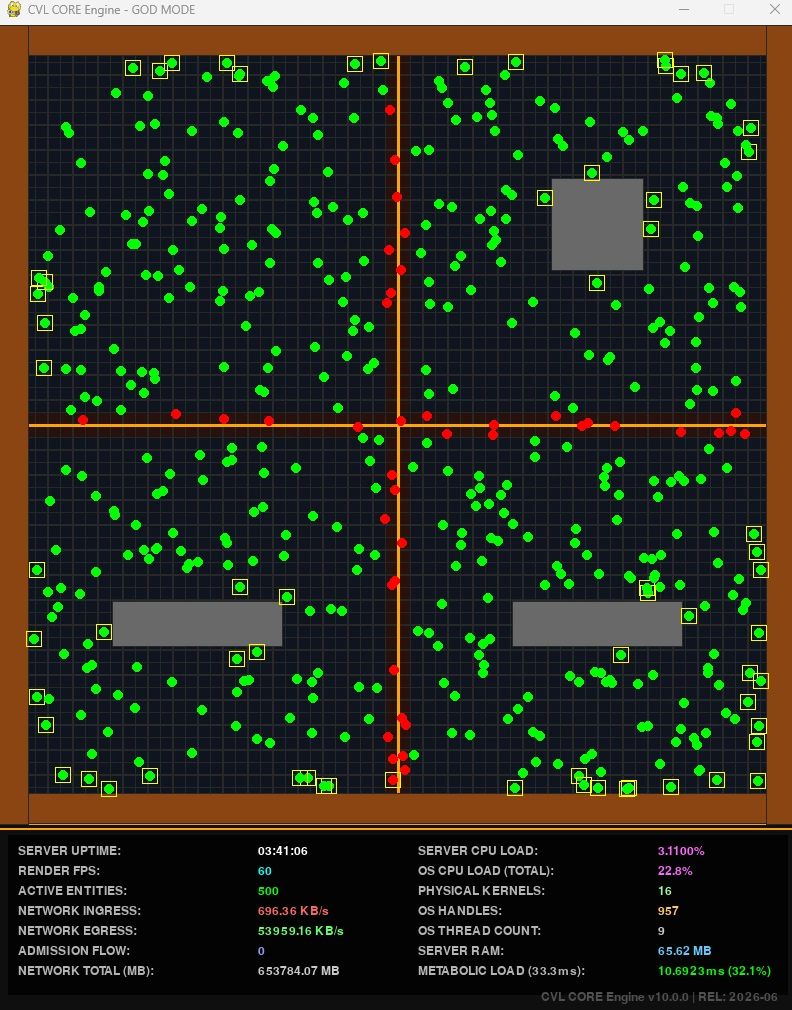
The production telemetry metrics below capture the CVL CORE Engine's operational baseline, cross-referenced and validated directly against our real-time hardware diagnostic layer:
Active Simulation Load: 500 Concurrent Full-Broadcast Entities
Monolithic Server Baseline: Headless instances of commercial engine frameworks routinely exhibit steep performance drops, rubber-banding, or frame degradation when forced to calculate, bucket, and broadcast spatial arrays across 500 concurrent connections.
Architectural Detail: The engine's low-overhead physics core processes kinematic translations, 9-cell spatial cell hashing, and boundary collision checks in a raw execution time of 0.073ms per entity.
Total Metabolic Frame Load: 10.69 ms (32.1% Single-Thread Saturation)
Monolithic Server Baseline: Standard multiplayer servers frequently redline or exhaust their rigid 16.6ms–33.3ms loop timebox under dense swarm loads, stealing vital cycles from game logic or pathfinding arrays.
Architectural Detail: By implementing our ultra-low-overhead LightProfiler tracking system to utilize atomic numerical counters instead of heavy string formatting decorators, we eliminated the "Observer Effect" performance tax entirely. The engine safely wraps its entire high-frequency network ingestion, payload de-serialization, spatial partitioning updates, and visual spectator loops within a 10.69ms envelope, leaving a massive 67.9% compute headroom margin open on the single thread.
Server Core Memory Footprint (RAM): 65.62 MB
Monolithic Server Baseline: Typically 400 MB to 1.2 GB+ for standard out-of-the-box engine dedicated servers idling with a baseline environment manifest initialized in memory.
Architectural Detail: Enforcing strict slots memory compliance strips out dynamic runtime object dictionaries (__dict__) entirely, compressing active data down to flat, predictable, contiguously pooled byte structures to completely bypass scene-graph memory bloat.
Asynchronous Outbound Egress Throughput: 53.96 MB/s (53,959.16 KB/s)
Architectural Detail: Multi-stride binary packet serialization loops are fully offloaded onto parallel non-blocking egress queues, allowing the engine to sustain heavy network saturation loads smoothly without stalling the primary logic thread or generating socket backpressure lag.
Inbound Network Ingress: 696.36 KB/s
Architectural Detail: Captures the raw, dense streaming array of packed 48-byte binary coordinate packets continuously flooding into our non-blocking socket selection registers.
Technical Benchmark Context & Equivalence Note: To maintain absolute transparency, these sandbox benchmarks evaluate a foundational, low-level spatial relay tracking a localized load of 500 entities utilizing a 12-variable/4-active kinematic vector payload. As shown in the diagnostic viewport, entities within proximity of architectural hazards—highlighted by an active yellow halo/circle—are concurrently executing proximity validation checks against the 3 environmental obstacles and all 4 outer map boundary walls.
Standard monolithic engine dedicated servers (e.g., standard headless Unity or Unreal framework builds) carry significantly higher resource footprints due to built-in scene graphs, deep transform hierarchies, and default component inheritance layers. The metrics above isolate the pure optimization gained by stripping away that monolithic middleware engine bloat in favor of a bare-metal spatial switchboard..
Dev Notes on Scaling Complexity:
These baselines represent our foundational relay layer executing spatial partitioning and boundary checks, with our 9-cell grid and world validation loops already active. As authoritative server state verification, combat resolution, and pathfinding networks are layered into the codebase, processing workloads will naturally scale. To absorb this upcoming structural weight seamlessly, our decoupled architecture targets compute, network, and modular constraints directly:
Compute Scaling (Milestone 3): Our hybrid architecture allows us to keep high-level asynchronous management in Python while expanding our existing, active native C memory matrices and kinematics loops out of the orchestrator plane and into a fully compiled, standalone native C shared library—ensuring pure machine-code execution speeds from day one.
Network Traffic Reduction (Future Milestones): The current 53.96 MB/s egress represents a raw, unoptimized stream. This network footprint will be drastically optimized down to a fraction of its baseline size via upcoming delta compression protocols, line-of-sight (LOS) occlusion filters, and distance-based interest management mechanics to stream data strictly to relevant observers.
Optional Modules (Future Roadmap): While high-concurrency architectures typically offload rigid entity-to-entity physics to the client to preserve performance, the CVL Core roadmap will include an optional, decoupled deterministic bounding-box verification module for developers requiring specialized server-side spatial interaction checks.
The CVL Core Engine Architecture Roadmap
🟢 Milestone 1: Core Architecture & Base Relay
Development Status: INTERNAL PROTOTYPE VALIDATED (Achieved)
The Engineering Paradigm: Focused entirely on zero-allocation packet parsing and timing stability. This phase successfully validated our high-speed socket multiplexer and the flat 48-byte binary inbound payload contract.
🟢 Milestone 2: Unity Visualizer Integration Test
Development Status: LABORATORY SANDBOX VERIFIED (Achieved)
The Engineering Paradigm: Validating that our custom bare-metal binary networking streams interface seamlessly with commercial front-end rendering engines without introducing thread locks or frame lag.
Verified Outcomes: Confirmed optimal synchronization via an active integration test scene inside the Unity engine. Testing verified that the external visualizer client handles real-time entity instantiation and movement interpolation in step with the server's spatial grid loops. While the visualizer renders the active characters and environment layout, the background CVL Core Engine manages 100% of the underlying spatial partitioning, cell binning, and boundary collision checks.
🟡 Milestone 3: Compute Scaling & Compiled C/C++ Core Migration
Development Status: ACTIVE DEVELOPMENT BUILD (Current R&D Focus)
The Engineering Paradigm: Shifting the high-frequency mathematical core out of interpreted runtime environments to support massive enterprise scaling.
Immediate Target: Migrating the active shared memory matrix buffers and physics loops out of the Python orchestration plane and into a fully compiled, standalone native C/C++ shared library (.so / .dll). By streaming raw memory address pointers via standard interop interfaces, the engine will execute spatial validations, boundary constraints, and 9-cell grid updates at pure machine-code speeds.
🟡 Milestone 4: Unity Developer Bridge & Client SDK
Development Status: ACTIVE INTEGRATION PIPELINE
The Engineering Paradigm: Packaging engine networking hooks into an out-of-the-box, non-blocking C# client framework.
Target Deliverables: Clean client-side SDK featuring automated snapshot ring buffering, predictive dead-reckoning with stationary culling, decoupled visual springs, and streamlined authentication handshakes.
🟡 Milestone 5: Scaled Concurrency & High-Density Spatial Telemetry (10,000+ Entities)
Development Status: ACTIVE CONCURRENT R&D (Expanding from 2k Baseline)
The Engineering Paradigm: Expanding the bare-metal spatial switchboard to power ultra-high-density virtual worlds and enterprise telemetry—supporting both massive-scale persistent MMO game environments and real-time industrial simulation pipelines.
Concurrent Engineering Focus: Building upon the engine’s empirically verified 2,000-bot saturation benchmark (sub-10ms steady-state tick budget), active development is progressing in parallel with the native compute migration to scale single-node ingestion and spatial processing to 10,000+ concurrent active entities.
Dual-Core Applications & Target Deliverables:
Massive MMO Virtual Worlds: High-capacity, authoritative single-shard server architectures capable of handling dense player hubs, massive open-world battles, and complex NPC ecosystem simulations without spatial partitioning lag or tick-rate degradation.
Enterprise Spatial Telemetry: Contiguous shared-memory matrix layouts and zero-allocation ingestion relays designed for autonomous drone swarm coordination, real-time industrial digital twins, automated logistics tracking, and massive multi-agent enterprise simulations.
🔵 Milestone 6: Unreal Engine Adapter & Native C++ Bridge
Development Status: PLANNED PIPELINE
The Engineering Paradigm: Porting the engine’s contiguously packed binary contracts into native C++ adapter layers, streaming high-frequency spatial streams directly into Unreal Engine's world partition and gameplay frameworks.
Target Deliverables: Lightweight, non-blocking native C++ client libraries and dedicated render-node network drivers tailored for Unreal Engine 5 builds.
🔵 Milestone 7: The Hybrid Mesh & Dynamic Interest Management
Development Status: FUTURE PLANNED PIPELINE
The Engineering Paradigm: The ultimate evolution of spatial architecture—merging broadcasting speed, massive telemetry tracking, and distributed cluster nodes into a single, highly context-aware system.
Planned Targets: Implementing intelligent "player interest tracking" algorithms. If entities cluster tightly in one zone, the local network layer dynamically upgrades them to full high-frequency broadcast, while distant entities drop to a quiet, low-frequency state to actively preserve cloud data bandwidth.
Core Technologies: Distance-based and Raycast occlusion filters, Dynamic Variable Tick Rates (1Hz for idle nodes, 60Hz for active zones), and Delta-Compression binary streaming.
💡 Ready to track our progress?
Standard networking middleware forces you to deploy heavy, bloated server instances just to track basic X, Y, and Z spatial coordinates. The CVL Core Engine cuts out the noise, functioning as a bare-metal spatial switchboard.
We are currently refining the internal codebase and framework libraries. Keep an eye on our architectural timeline as we steadily build out the developer pipelines to bridge custom Unity, Unreal, or custom web stacks straight into our low-level tracking core.
"CVL Core Engine (formerly developed under the working title Project Celonix)"